Table of Contents
WorkDash vs Multiple Tools: How One All-in-One Digital Workplace Beats App Overload
Modern businesses were promised better productivity through digital tools. Instead, many teams are drowning in app overload, juggling dozens of platforms just to get through a single workday. From project management tools and collaboration apps to CRMs, invoicing systems, and spreadsheets, the modern digital workplace has become fragmented, noisy, and inefficient.
This article breaks down why multiple tools are killing productivity, how tool overload creates friction across the workplace, and why consolidating into one all-in-one digital platform like WorkDash is the smarter path forward. We’ll explore the real cost of juggling many apps, the role of AI in the modern workplace, and how a unified digital workspace helps teams focus on real work—not switching between apps.
Article Outline: One Platform vs App Overload
1. What Is App Overload and Why Is It Hurting the Workplace?
2. How Did the Digital Workplace Become So Fragmented?
3. The Real Productivity Cost of Too Many Apps
4. Why Context Switching and Tool Overload Kill Focus
5. How AI Is Changing the Digital Workplace
6. What Does an All-in-One Digital Platform Actually Mean?
7. Consolidation vs Adding More Tools: What Works Better?
8. How One Unified Digital Workspace Improves Teamwork
9. Why WorkDash Beats Juggling Multiple Tools
10. The Future of Work: One Platform, Not Many Apps
What Is App Overload and Why Is It Hurting the Workplace?
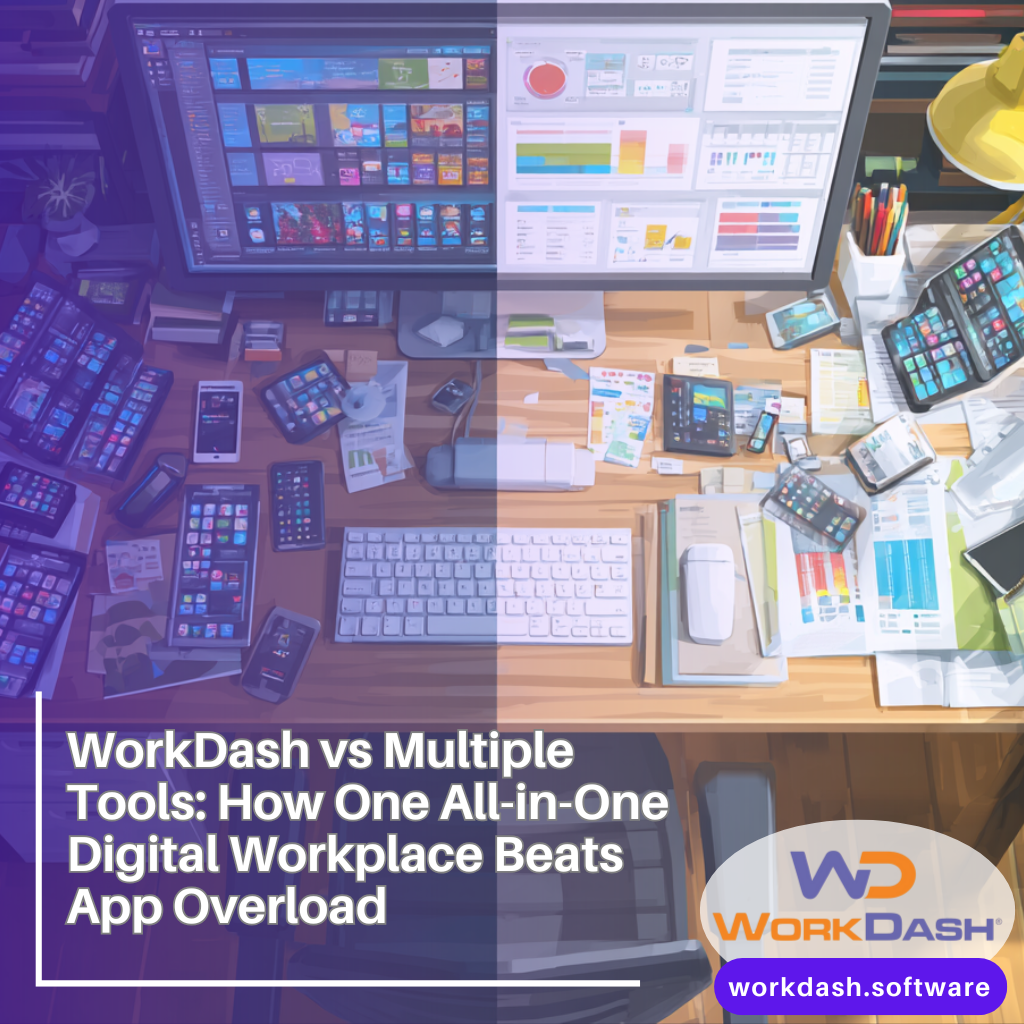
App overload happens when employees must use too many applications to complete daily work. Instead of a streamlined workflow, teams juggle many apps for communication, tasks, documents, billing, customer data, and reporting. This creates overload, confusion, and fatigue across the workplace.
In a typical digital workplace, employees switch between collaboration apps, spreadsheets, project tools, CRMs, and email threads just to complete basic tasks. This fragmentation leads to lost information, missed updates, and declining productivity. The workplace becomes reactive instead of focused.
How Did the Digital Workplace Become So Fragmented?
The rise of SaaS promised flexibility, but it also created chaos. Each new problem led to new tools, resulting in a bloated tech stack. Instead of one coherent workspace, businesses adopted many platforms that rarely talk to each other.
Business leaders often add tools without removing old ones. Over time, workflows become scattered across different apps, creating silos. Information is fragmented, teams lose visibility, and the digital workplace becomes harder—not easier—to manage.
The Real Productivity Cost of Too Many Apps
According to Harvard Business Review, employees spend a significant portion of their day switching between tools instead of doing meaningful work. This constant toggle between apps creates a mental drain and contributes to decreased productivity.
Every time a worker switches context, focus is lost. Notifications interrupt flow, and people spend time searching for information instead of acting on it. Over time, this drain impacts employee productivity, morale, and output across the workplace.
Why Context Switching and Tool Overload Kill Focus
Tool overload forces people to constantly juggle platforms. One task may require opening five different systems, copying data, and checking notifications across multiple channels. This creates friction and slows execution.
Context switching increases errors, duplication, and rework. Instead of focusing on outcomes, teams focus on managing tools. When tools slow people down, productivity suffers and real work gets delayed.
How AI Is Changing the Digital Workplace
AI is rapidly reshaping how people work. Instead of acting as another tool, AI has the potential to reduce complexity—if implemented correctly. In a fragmented workplace, AI becomes just another disconnected feature.
In a unified digital workplace, AI can automate workflows, surface insights, reduce manual steps, and guide decision-making. AI works best when it operates across one connected system rather than scattered tools. This is where consolidation becomes essential.
What Does an All-in-One Digital Platform Actually Mean?
An all-in-one digital platform replaces scattered tools with one connected workspace. Instead of switching between systems, teams work in one platform that handles workflows, communication, data, and reporting together.
This doesn’t mean “more features.” It means fewer tools, less friction, and better integration. A true all-in-one digital workspace simplifies the tech stack while improving clarity, speed, and productivity.
Consolidation vs Adding More Tools: What Works Better?
When productivity drops, many organisations respond by adding tools. The result is more apps, more notifications, and more complexity. Consolidation takes the opposite approach—removing unnecessary tools and unifying workflows.
By reducing the number of platforms, businesses reduce friction and improve focus. Consolidation aligns teams around shared processes and data, helping everyone stay on the same page and work more efficiently.
How One Unified Digital Workspace Improves Teamwork
A unified digital workspace brings communication, tasks, and data into one connected space. Teams no longer chase updates across email, chat apps, and dashboards. Everything lives in a single source of truth.
This improves teamwork by reducing silos and improving transparency. Managers and employees see the same information, workflows are visible, and collaboration becomes intentional instead of reactive.
Why WorkDash Beats Juggling Multiple Tools
WorkDash is designed to replace multiple tools with one flexible platform. Instead of forcing businesses into rigid systems, WorkDash adapts to how teams actually work.
By combining workflows, automation, AI, and collaboration into one management platform, WorkDash eliminates app fatigue and simplifies the digital workplace. Teams stop juggling tools and start focusing on outcomes.
The Future of Work: One Platform, Not Many Apps
The future of work is not about more tools—it’s about better systems. Businesses that reduce app overload and adopt a unified digital workplace will outperform those stuck in fragmented environments.
One connected platform powered by AI allows people to work smarter, not harder. It reduces friction, improves productivity, and helps teams stay organised in an increasingly competitive landscape.
Key Takeaways: Why One Platform Beats App Overload
App overload reduces productivity and increases fatigue
Too many tools fragment the digital workplace
Context switching drains focus and slows execution
AI works best in a unified digital environment
Consolidation improves clarity and teamwork
An all-in-one digital platform reduces friction
One workspace replaces juggling multiple apps
Teams stay aligned and productive
WorkDash simplifies the modern workplace
The future is one platform—not many tools