Table of Contents
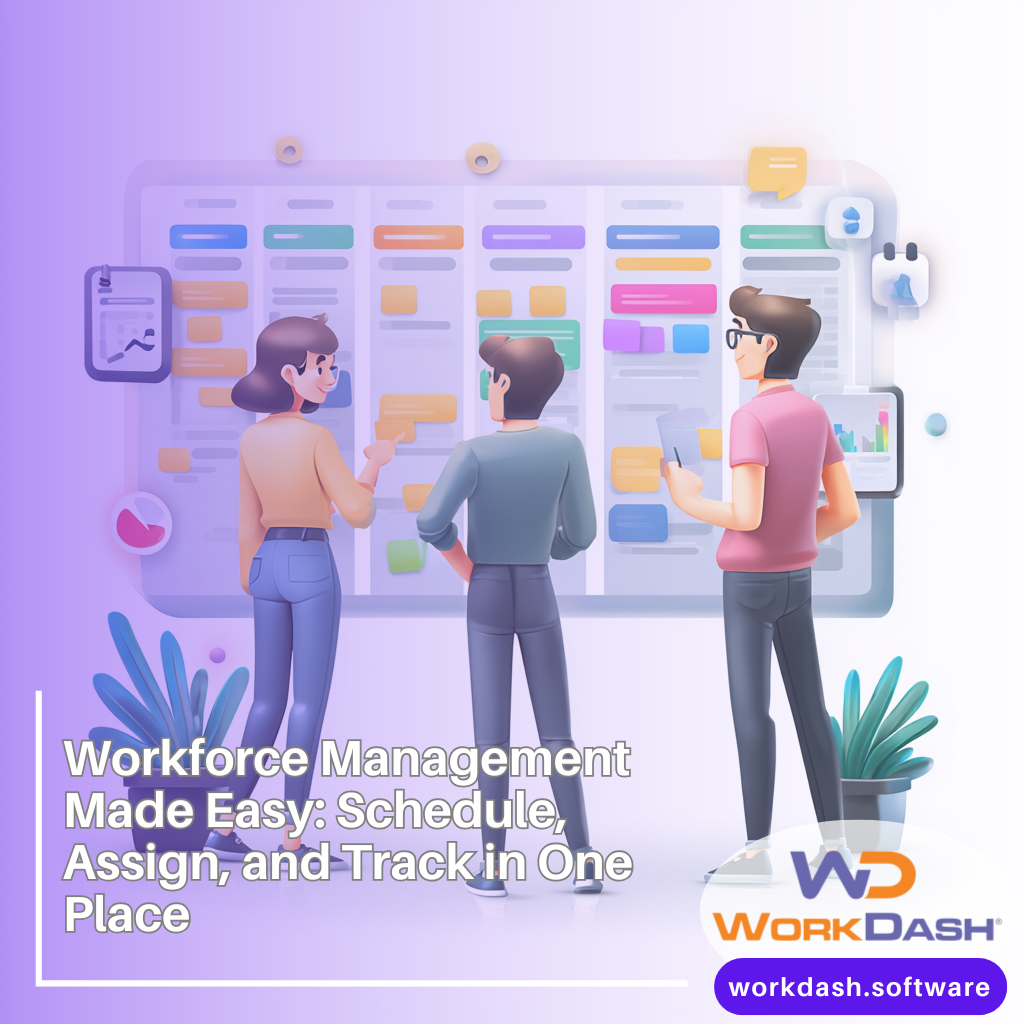
Workforce Management Made Easy: Schedule, Assign, and Track in One Place
Managing people is one of the most complex parts of running a modern business. From creating an accurate employee schedule and handling payroll, to tracking hours, overtime, and availability, poor systems quickly lead to errors, frustration, and rising labor cost. This is why workforce management software has become essential—not just for large enterprises, but for growing teams that need clarity and control.
This article explains how workforce management made easy is no longer a slogan, but a practical reality when scheduling, assigning, and tracking work happens in one place. You’ll learn what effective workforce management looks like today, why all-in-one platforms outperform disconnected tools, and how WorkDash delivers a modern workforce management platform without ERP complexity.
Article Outline
What Is Workforce Management and Why Does It Matter Today?
Why Traditional Rosters and Spreadsheets No Longer Work
How Workforce Management Software Simplifies Employee Scheduling
Can You Really Schedule in Minutes Without Errors?
Time Tracking, Timesheets, and the End of Guesswork
How Payroll and Workforce Management Should Work Together
Forecasting, Overtime, and Controlling Labor Costs
Mobile Apps, Real-Time Data, and the Modern Workforce
One Workforce Management Platform, Not Ten Different Tools
Why Workforce Management Made Easy Is a Competitive Advantage
What Is Workforce Management and Why Does It Matter Today?
At its core, workforce management is the process of planning, scheduling, tracking, and optimising how people work. This includes employee schedule creation, time tracking, attendance tracking, payroll inputs, and compliance.
For many businesses, workforce challenges grow faster than revenue. Managers spend hours adjusting a roster, chasing timesheets, and reconciling work hours before payroll runs. These manual processes introduce errors, reduce morale, and slow down decision-making.
A modern workforce management solution centralises every aspect of your workforce so managers and employees operate from one source of truth. This shift isn’t about control—it’s about clarity, fairness, and efficiency.
Why Traditional Rosters and Spreadsheets No Longer Work
Many teams still rely on spreadsheets, whiteboards, or paper rosters. While familiar, these tools don’t scale and don’t reflect the realities of a modern workforce.
Spreadsheets struggle with shift changes, availability updates, overtime calculations, and approvals. They don’t integrate with payroll, don’t support real-time updates, and require manual reconciliation.
A dedicated rostering software replaces fragile spreadsheets with a structured system that reduces errors, improves visibility, and ensures everyone is working from up-to-date information.
How Workforce Management Software Simplifies Employee Scheduling
Effective employee scheduling software removes complexity from the scheduling process. Instead of juggling emails and spreadsheets, managers can create a complete work schedule in one place.
With workforce management software, schedules are built using templates, availability rules, and pay rates. This ensures the right people are scheduled at the right time, every time.
By centralising staff scheduling, businesses can streamline operations, reduce scheduling conflicts, and improve the overall employee experience.
Can You Really Schedule in Minutes Without Errors?
Yes—when scheduling is designed properly. Modern systems allow managers to schedule in minutes using drag-and-drop tools, reusable templates, and automated checks.
A smart roster highlights conflicts, flags overtime risks, and respects employee availability. This prevents errors before they happen, rather than fixing them after payroll.
By using a customizable scheduling approach, businesses gain flexibility without losing control—making scheduling fast, accurate, and repeatable.
Time Tracking, Timesheets, and the End of Guesswork
Manual timesheets are one of the biggest sources of payroll errors. Employees forget to log hours, managers chase approvals, and finance teams reconcile discrepancies.
Integrated time tracking solves this by recording employee time automatically. With a digital clock, employees can clock in and clock out accurately, whether on-site or remote.
This improves attendance tracking, ensures accurate work hours, and gives managers confidence that payroll inputs are correct before processing.
How Payroll and Workforce Management Should Work Together
When payroll and workforce systems are disconnected, errors multiply. Hours worked don’t match pay, overtime calculations are wrong, and corrections become routine.
A unified workforce management system ensures that schedules, time tracking, and payroll data flow seamlessly. Approved timesheets feed directly into payroll software, reducing manual entry.
This integration helps reduce errors, supports compliance, and ensures employees are paid accurately and on time—every pay cycle.
Forecasting, Overtime, and Controlling Labor Costs
Unplanned overtime is one of the fastest ways to increase labor cost. Without visibility, managers often discover overruns after payroll has already been processed.
Modern workforce management tools provide the ability to forecast staffing needs based on demand, past data, and trends. This allows proactive scheduling instead of reactive fixes.
With clear forecasts and real-time data, businesses can control labor costs, minimise unnecessary overtime, and optimise staffing without sacrificing service quality.
Mobile Apps, Real-Time Data, and the Modern Workforce
Today’s teams are mobile, flexible, and distributed. A modern mobile app ensures employees can view schedules, update availability, and track time from anywhere.
A mobile app allows employees to request time off, swap shifts, and stay informed—reducing admin workload for managers.
With real-time updates, everyone works from the same information, improving trust, communication, and productivity across the workforce.
One Workforce Management Platform, Not Ten Different Tools
Many businesses rely on separate systems for scheduling, time tracking, payroll, and HR. This fragmentation increases cost and complexity.
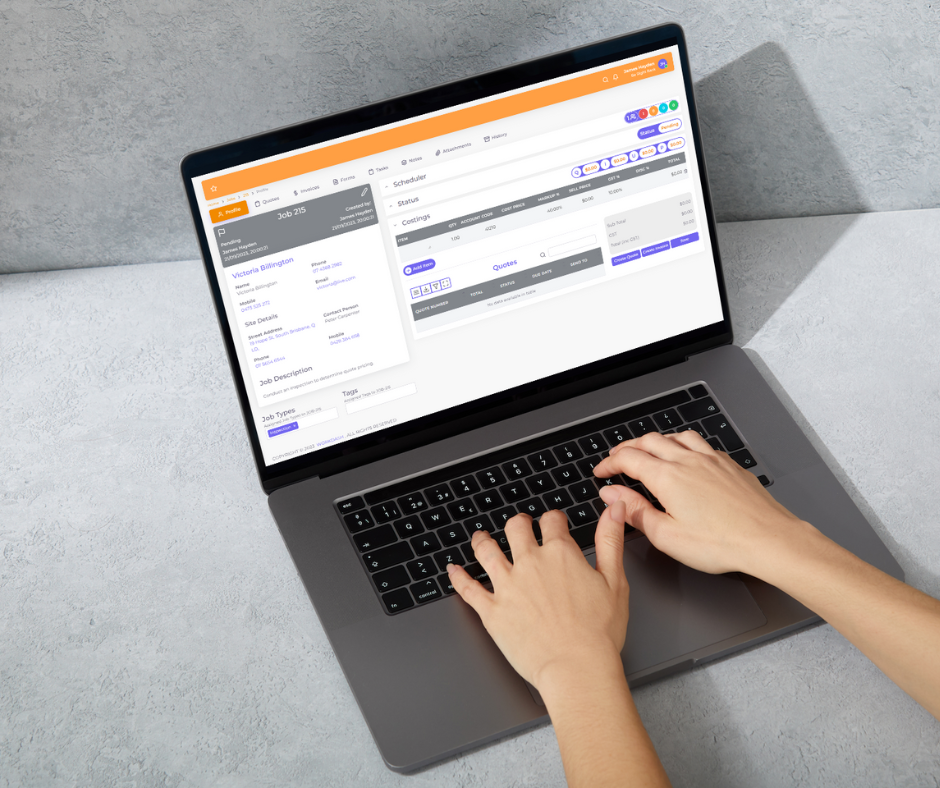
An all-in-one workforce management platform brings everything together in one platform. Scheduling, tracking, approvals, and reporting live in a single interface.
WorkDash provides a unified platform designed to manage every aspect of your workforce—without becoming an ERP. It focuses on practical workforce needs, not enterprise overhead.
Why Workforce Management Made Easy Is a Competitive Advantage
When workforce systems are simple and reliable, managers spend less time fixing problems and more time leading teams.
Employees benefit from transparent schedules, accurate pay, and better communication. Managers gain visibility through dashboards and analytics. Leadership benefits from improved productivity and efficiency.
Ultimately, workforce management made easy isn’t just about saving time—it’s about building a resilient, scalable business.
Key Benefits of Workforce Management Made Easy
Centralises workforce management in one location
Simplifies employee schedule creation and rostering
Improves accuracy of payroll and timesheets
Reduces labor cost and unnecessary overtime
Enables real-time visibility and forecasting
Supports mobile access for a modern workforce
Replaces spreadsheets with structured workflows
Improves employee experience and trust
Reduces admin effort and manual errors
Scales with your business as teams grow
Final Thoughts
Managing people shouldn’t feel harder than managing customers or projects. With the right workforce management software, scheduling, assigning, and tracking work becomes simple, accurate, and scalable.
WorkDash delivers a modern workforce management solution that brings scheduling, time tracking, payroll inputs, and analytics together—without ERP complexity.
If your team is growing and workforce admin is slowing you down, it may be time to manage your workforce in one place—and finally make workforce management easy.