Table of Contents
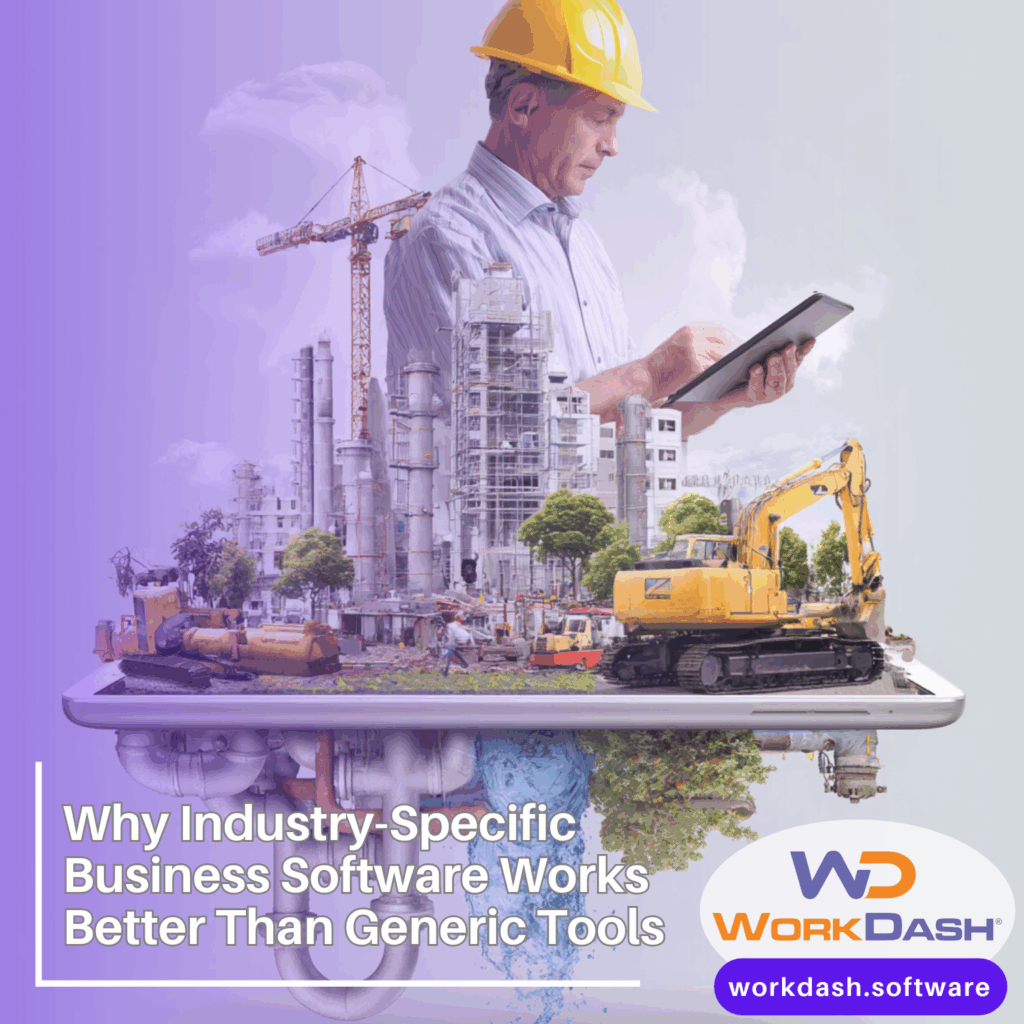
Why Industry-Specific Business Software Works Better Than Generic Tools and ERP
In the modern business landscape, efficiency, accuracy, and adaptability are everything. Yet, many growing organisations still rely on generic tools or outdated ERP software that try to do everything—but fail to meet the specific needs of individual industries.
That’s where industry-specific software comes in. Unlike generic ERP systems, industry-specific ERP solutions are designed to streamline operations, automate complex workflows, and deliver features tailored to their industry. For service-based businesses, platforms like WorkDash offer a smarter, faster, and more intuitive alternative—helping teams manage operations, quotes, invoices, jobs, and compliance without the unnecessary complexity of an enterprise resource planning (ERP) system.
This article will explore why industry-specific software outperforms generic ERP solutions, what features truly matter, and how WorkDash helps Australian service businesses operate with precision and ease.
What Makes Industry-Specific Software Different from Generic ERP?
When comparing industry-specific ERP systems to generic ERP software, the biggest difference lies in their focus.
Generic software is designed to fit many industries at once. While flexible, it often feels cluttered, complex, and filled with irrelevant features. Teams spend time customizing modules, hiring consultants, and integrating add-ons just to make it work.
In contrast, industry-specific software is built around your business processes from day one. It offers software solutions that reflect real-world workflows, ensuring the system feels intuitive and relevant to your staff. For example, WorkDash provides a management software suite tailored to service and trade businesses—delivering automation, CRM software, inventory management, and quoting tools that feel natural for your workflow.
Why Industry-Specific ERP Software Works Better for Business Growth
A specialised ERP focuses on one thing: helping your business grow within your niche. It provides industry-specific features that simplify operations, reduce overhead, and ensure compliance with industry standards.
For instance, instead of spending hours configuring a generic ERP system, a business using WorkDash can deploy instantly with templates already built for project management, customer communication, and billing. This enables teams to streamline work and improve efficiency from day one.
As your organisation expands, an industry-specific ERP solution scales with you—adapting to your specific industry requirements instead of forcing your business to adapt to the software.
Why Generic ERP Systems Fail to Meet Industry Needs
While ERP software often claims to be universal, it struggles to meet the industry needs of specialized sectors. Generic ERP tools try to appeal to everyone but end up serving no one particularly well.
They require costly customizations, constant maintenance, and third-party software packages to fill gaps. Worse, the workflow is rarely optimized for your business type—creating inefficiencies that slow teams down.
By contrast, WorkDash’s industry-specific business software simplifies operations through automation and smart integration. You get all the tools you need—without the unnecessary modules and add-ons of a generic ERP solution.
Examples of Industry-Specific Software That Transform Operations
Every industry has unique demands. From construction to healthcare to logistics, there’s no such thing as a one-size-fits-all system. Let’s look at examples of industry-specific software in action:
Construction & Trades: WorkDash provides job tracking, quoting, and inventory management designed for contractors.
Hospitality: POS and booking systems streamline workflow and customer service.
Healthcare: Patient management systems streamline processes and ensure compliance with data laws.
These industry-specific software solutions eliminate redundancy, reduce manual effort, and help businesses focus on delivering better results—not managing tools.
What Are the Benefits of Industry-Specific ERP Software?
The benefits of industry-specific solutions are clear and measurable:
Tailored Functionality: Systems are tailored to their industry, removing unnecessary features.
Improved Productivity: Teams spend less time adapting to software and more time doing real work.
Faster Implementation: Deployment happens in days, not months.
Better Integration: Tools are built for your existing systems and supply chain operations.
WorkDash takes these benefits further. Its industry-specific management software integrates quoting, job tracking, and compliance automation—making it one of the most effective business management tools available to Australian service providers.
How Industry-Specific Solutions Help Streamline Operations
Industry-specific ERP tools streamline operations by automating repetitive processes and improving coordination across teams.
For instance, WorkDash eliminates manual quoting, scheduling, and invoice handling. Data flows automatically from job creation to completion, ensuring streamline workflows with no double entry.
This approach allows businesses of all sizes to maintain visibility, reduce human error, and make data-driven decisions. Whether in the office or the field, WorkDash ensures your organisation functions like a well-tuned machine.
Why You Don’t Need a Generic ERP Solution
The phrase “need an industry-specific ERP” is more relevant than ever. Many service-based companies realize that ERP systems—originally designed for manufacturing and enterprise corporations—are overkill for their needs.
Generic ERP software can be expensive, difficult to configure, and packed with features your business will never use. By choosing a focused industry-specific ERP software, you get the right tool for the right business without unnecessary complexity.
WorkDash is a perfect example. It delivers all the power of a business software platform—without the heavy cost, training time, or bloat of a generic system.
How Integration and Automation Improve Efficiency
A key advantage of industry-specific solutions is integration and automation. Unlike generic software, which relies on plugins and third-party software, industry-specific ERP systems connect data across departments seamlessly.
For example, when a quote is approved in WorkDash, it can automatically trigger job creation, staff allocation, and invoice generation—all within the same software product. This eliminates manual duplication and saves hours every week.
By automating business processes, companies can reduce admin time, increase productivity, and provide better service to clients.
Industry-Specific vs Generic ERP: Which Delivers Better ROI?
When comparing industry-specific vs generic ERP, the difference in ROI is dramatic. Generic ERP systems require more configuration, longer training, and more ongoing maintenance—all of which add cost.
Industry-specific ERP software, however, is ready to use from day one. It reduces setup costs and maximizes value faster. With WorkDash, your team can deploy workflows, collect payments, and track performance without coding or external consultants.
This simplicity delivers better ROI—both in terms of productivity and long-term business growth.
How to Choose the Right Industry-Specific ERP Solution
Selecting the right software depends on your business needs, budget, and future scalability. When selecting a new ERP, businesses should consider:
Is it designed for my specific industry?
Does it integrate with my current systems?
Can it scale as my business grows?
Is it user-friendly for my team?
WorkDash ticks all these boxes. Unlike heavy ERP software, it’s built for service-based industries that need agility—not enterprise bloat. Its software development is guided by industry experts, ensuring solutions are tailored to real-world challenges faced by Australian service businesses.
How WorkDash Outperforms Generic Business Software
While generic ERP systems focus on enterprise complexity, WorkDash focuses on clarity, automation, and ease of use. It’s not an ERP system, but a business management platform created specifically for small and medium Australian service companies.
It helps businesses streamline workflows, track inventory management, automate invoicing, and improve integration between field and office teams.
Unlike using generic software, which requires adapting your organisation to the tool, WorkDash software adapts to your business operations—providing a more natural, tailored to their industry experience.
Key Takeaways: Why Industry-Specific Software Wins
Industry-specific software delivers precise functionality tailored to your industry, improving usability and outcomes.
Generic ERP systems are broad, complex, and filled with unnecessary modules.
WorkDash offers business management software that replaces generic ERP for service-based industries.
Integration and automation features help streamline operations, reduce costs, and boost productivity.
Choosing industry-specific solutions ensures faster deployment, better scalability, and long-term business growth.
Every organisation can improve efficiency by selecting the right tool designed for its specific industry.
In conclusion, industry-specific software isn’t just a trend—it’s the smarter, more effective way forward. For modern service businesses, a platform like WorkDash provides all the features of a specialised ERP—without the weight of an enterprise system.
👉 Explore WorkDash.software today to discover how our industry-specific management software helps you streamline processes, automate tasks, and scale with confidence—designed for your industry, not everyone’s.