Table of Contents
Why Small Businesses Need an All-in-One Business Management Platform
Running a small business today is more complex than ever. Owners are expected to manage customers, projects, finances, teams, and data—often across multiple disconnected tools. This is why business management software has evolved, and why more small business owners are moving toward an all-in-one business management platform instead of juggling spreadsheets, point solutions, or heavyweight ERP systems.
This article explains why small businesses need an all-in-one business management platform, what problems it solves, and how platforms like WorkDash help growing businesses streamline operations, improve productivity, and scale confidently—without becoming an ERP.
Article Outline
What Is Business Management and Why Does It Matter for Small Business?
Why Traditional Business Management Software Falls Short
What Does “All-in-One” Really Mean for Small Businesses?
How an All-in-One Business Management Platform Improves Productivity
Why CRM Is the Foundation of Modern Business Management
How Project Management and Workflow Tools Replace Chaos
Why Integration Beats Multiple Tools and Platforms
Real-Time Dashboards, Analytics, and Better Decision-Making
All-in-One Business Management Without ERP Complexity
The Long-Term Benefits for Growing Businesses
What Is Business Management and Why Does It Matter for Small Business?
Business management is the coordinated control of people, processes, data, and customers to achieve business goals. For a small business, this often starts informally—with spreadsheets, email, and manual tracking—but quickly becomes unsustainable as the business grows.
Without structured business management software, daily operations become fragmented. Information is stored in different places, processes rely on individuals, and visibility across the business is limited. This makes it harder for a business owner or manager to understand performance, manage customers, or respond quickly.
An effective business management platform centralises core business functions, providing clarity, consistency, and control—key ingredients for long-term success.
Why Traditional Business Management Software Falls Short
Many small businesses adopt software one problem at a time: a CRM for sales, accounting software for finances, a project management tool for delivery, and another platform for support. While each tool may work well on its own, together they create friction.
Using multiple tools across multiple platforms leads to duplicated data, manual updates, and disconnected workflows. Customer information lives in one system, project updates in another, and financial data somewhere else entirely.
Traditional solutions—especially ERP systems—promise integration but often come with high cost, long implementation times, and unnecessary complexity. Small businesses need business management software that fits their reality, not enterprise overhead.
What Does “All-in-One” Really Mean for Small Businesses?
An all-in-one approach doesn’t mean “everything and the kitchen sink.” For small businesses, it means having the right tools in one platform, designed to work together seamlessly.
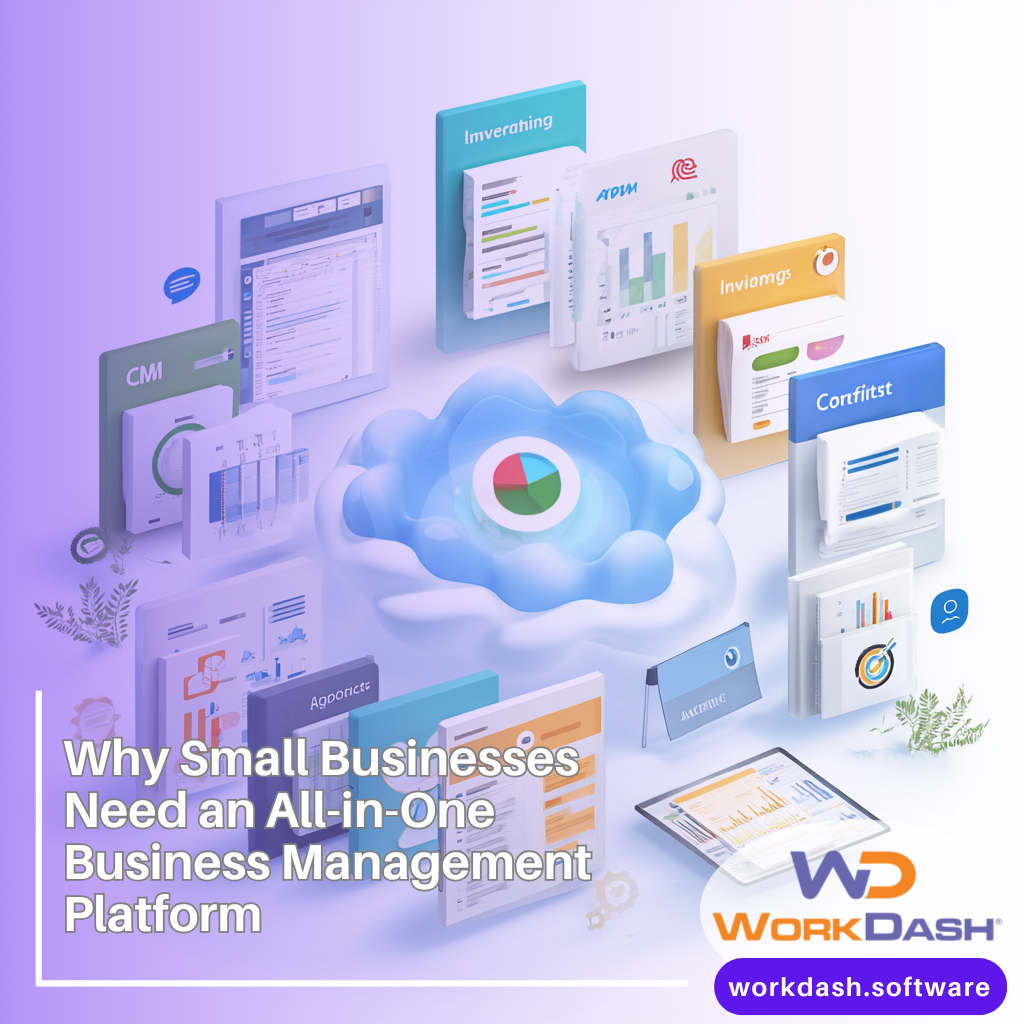
An all-in-one business management platform typically includes CRM, project management, workflow automation, dashboards, and integrations—without forcing businesses into rigid ERP structures.
With all-in-one business management, data is stored in one place, workflows are connected, and teams work from a single source of truth. This reduces friction, saves time, and improves decision-making.
How an All-in-One Business Management Platform Improves Productivity
Productivity is one of the biggest challenges for any small business. Time lost switching between tools, searching for information, or fixing errors adds up quickly.
An all-in-one solution improves productivity by centralising tasks, data, and communication. Teams spend less time managing systems and more time doing meaningful work.
Platforms like WorkDash automate repetitive tasks, streamline workflows, and provide real-time visibility into business operations. This allows small teams to achieve more without increasing headcount.
Why CRM Is the Foundation of Modern Business Management
At the heart of modern business management software is CRM—Customer Relationship Management. CRM is no longer just about sales; it’s about managing every interaction with customers.
A strong CRM system stores customer data, communication history, tasks, and activities in one place. This improves customer experience, consistency, and responsiveness.
With CRM software built into an all-in-one platform, customer information flows seamlessly into projects, invoices, support, and reporting—eliminating silos and improving customer satisfaction.
How Project Management and Workflow Tools Replace Chaos
As small businesses grow, informal task tracking breaks down. Emails get missed, responsibilities blur, and deadlines slip. This is where project management and workflow tools become essential.
An integrated project management system allows teams to track tasks, milestones, and progress in real time. Clear ownership and visibility reduce confusion and improve accountability.
When combined with workflow automation, businesses can eliminate manual processes, reduce errors, and ensure consistency across operations—without relying on spreadsheets or memory.
Why Integration Beats Multiple Tools and Platforms
One of the biggest advantages of an all-in-one platform is the ability to integrate business processes natively, rather than stitching tools together.
Using separate systems often requires manual data entry, third-party connectors, or complex workarounds. This increases risk and reduces reliability.
An integrated business management platform ensures business data flows smoothly between CRM, project management, accounting software, and analytics—without friction. This improves efficiency and trust in the data.
Real-Time Dashboards, Analytics, and Better Decision-Making
Small business owners need visibility to make informed decisions. Without it, they rely on intuition rather than data.
An all-in-one platform provides real-time dashboards and analytics, showing performance across sales, projects, customers, and operations. This allows owners to identify issues early and act quickly.
Having business data in one place improves business performance, reduces surprises, and supports proactive management rather than reactive firefighting.
All-in-One Business Management Without ERP Complexity
Many small businesses assume they need an ERP to get control—but ERP systems are often overkill. They introduce rigid processes, high costs, and long implementation cycles.
WorkDash is not an ERP. It is a business management platform designed specifically for small and growing businesses that need flexibility, speed, and simplicity.
By focusing on core business needs—CRM, workflows, project management, dashboards, and automation—WorkDash delivers the benefits of all-in-one software without ERP baggage.
The Long-Term Benefits for Growing Businesses
For growing businesses, scalability matters. An all-in-one platform grows with the business, supporting new workflows, users, and integrations over time.
Instead of replacing systems every few years, businesses can build on a single platform that adapts to changing needs. This reduces disruption and long-term costs.
Ultimately, all-in-one business management software helps small businesses save time, improve customer experience, and build a stronger foundation for sustainable growth.
Key Benefits of Using an All-in-One Business Management Platform
Centralises business management in one platform
Reduces reliance on multiple tools and spreadsheets
Improves productivity and workflow efficiency
Provides integrated CRM and customer management
Supports project management and task tracking
Delivers real-time dashboards and analytics
Enhances customer experience and satisfaction
Eliminates ERP complexity for small business
Scales as the business grows
Saves time and reduces operational costs
Final Thoughts
Small businesses don’t fail because of lack of effort—they fail because systems don’t scale with growth. An all-in-one business management platform gives business owners clarity, control, and confidence.
WorkDash brings together CRM, workflows, project management, and analytics into a single, flexible platform—helping small businesses run smarter, faster, and without unnecessary complexity.
If your business is outgrowing spreadsheets and disconnected tools, it may be time to rethink how you manage your business—all in one place.